Context
TIMELINE
May 2025 - Aug 2025
INDUSTRY
Fintech
CONTRIBUTION
Product Design, Conversational AI Design
COLLABORATORS
Conversational AI Designers, Product Designers
I led product design for a personalized onboarding experience inside Rocket's AI assistant, focused on first-time homebuyers at the post-offer stage. The work went beyond conversational UI. I defined an interaction system that included task-based UI modules, card and carousel components and contextual prompt patterns. I worked closely with product managers, researchers and engineers to prototype and test the experience. Some of the interaction patterns I introduced are now part of ongoing roadmap discussions.
the challenge
Where homebuyers start to feel lost
Once a home offer is accepted, buyers enter a short but critical stage of the mortgage journey. Within a 7–10 day window they must complete inspections, review documents, coordinate with sellers and make decisions that directly affect their purchase. Buying a home is an emotional journey and getting your offer accepted is a milestone in itself. Where the buyers should be celebrating this moment, this stage ends up making them confused, rushed and overwhelmed.

As a result, many clients turned to Rocket Mortgage's support channels to understand what to do next. While Rocket Mortgage provides tools like the Rocket Assist AI Assistant and SME chat specialists, the guidance available at this moment is largely generic and disconnected from each client’s specific situation.
This created two problems. Buyers felt uncertain about their progress and support teams saw increased call volume during one of the most time-sensitive moments of the journey. The challenge was how to introduce clear and contextual guidance, that would help buyers understand what to do next while reducing the need for reactive support.
key design decisions
Shifting the experience from reactive support to guided progress
To reduce confusion without adding friction, I explored how guidance could appear naturally within the onboarding experience. Rather than adding new screens or forcing users through rigid flows, my goal here was to introduce guidance that could adapt to where buyers were in their journey.
This led to three key interaction shifts that shaped how Rocket Assist supports clients during the post-offer stage.
What's inside the full case study
The password-protected section covers the complete design process including the UI component system, high-fidelity screens, how the research shaped the interaction decisions and the usability testing results.
If you are reviewing this for a product design role, the component work and interaction system are the most relevant parts. The password is on my resume.
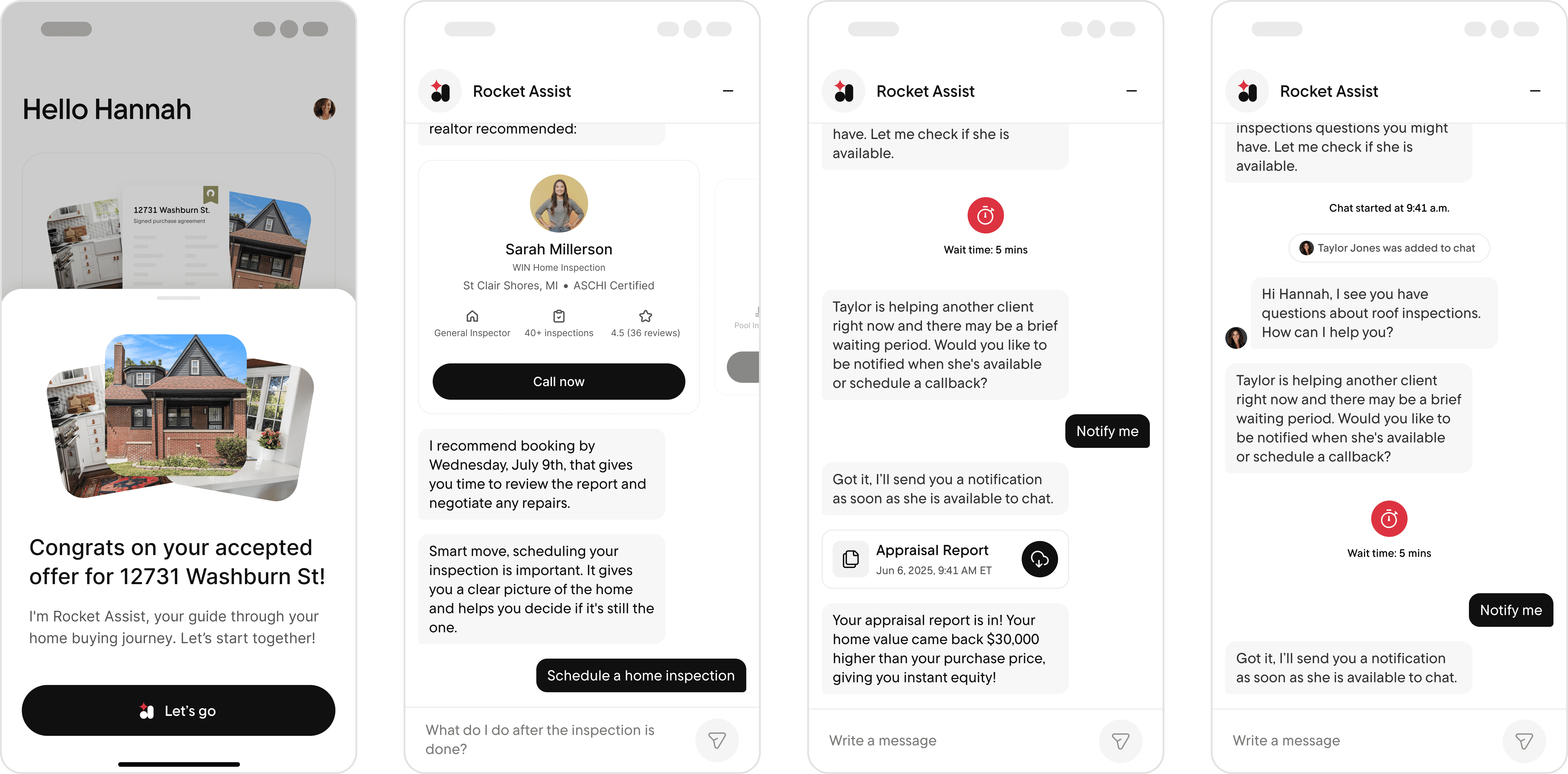
Guidance inside conversation
Early conversations with support teams and chat conversations analysis revealed that many clients used Rocket Assist primarily to ask “What should I do next?”. However, the existing assistant responded with text explanations that often required users to navigate elsewhere in the dashboard to complete tasks.
To address this gap, I explored ways to introduce task-based UI modules directly within the conversation flow. I worked on expanding the assistant beyond a purely conversational interface to combine conversational guidance with actionable UI elements that would provide the clients specific guidance on how to move forward with the mortgage process, all without leaving the chat interface.
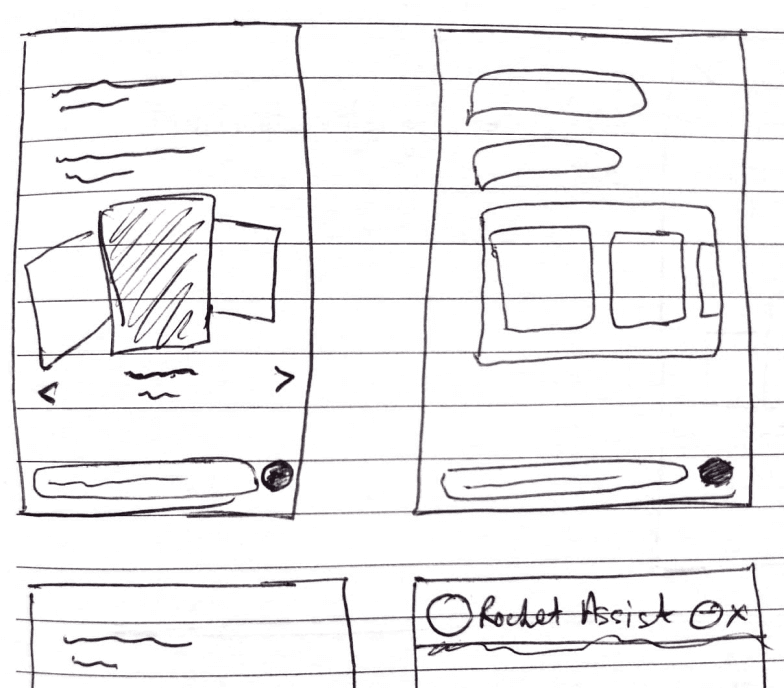
Sketches of early exploration of the task carousel element.
These modules surfaced the most relevant next steps, like reviewing documents, checking appraisal status and preparing for inspections, while still preserving the flexibility of a conversational interface. This approach helped anchor the experience around clear next actions, reducing the cognitive load for users navigating the process for the first time.
Experience That Goes Beyond Conversational UI
Traditional chat interfaces rely heavily on text responses, which can quickly become repetitive and difficult to scan during longer interactions. In a complex process like mortgage onboarding, purely conversational responses were not always the most effective way to guide users through tasks.
To address this, I introduced visual interaction components within the assistant experience. Elements such as cards, carousels, contact cards, dynamic prompt buttons, and document downloads allowed the assistant to present information in a more structured and actionable format.
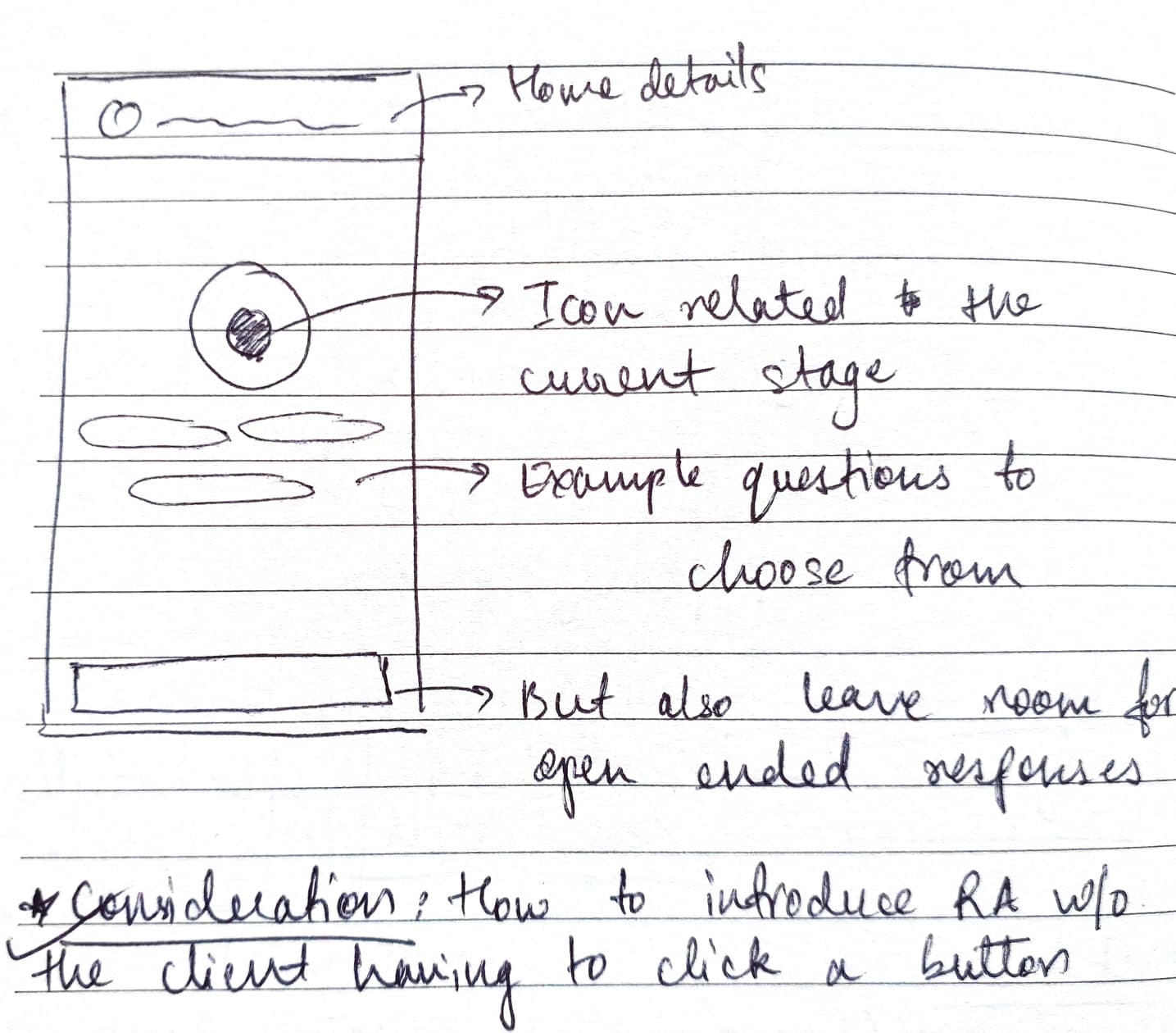
Exploring the details of how to provide context-aware information
These visual elements helped break the monotony of a text-heavy interface while giving users faster ways to understand options and move forward. Instead of reading through long explanations, clients could interact directly with UI components that surfaced relevant information and actions within the conversation.
Knowing when AI should step aside
While AI can guide users through many steps of the process, mortgage decisions often involve complex financial questions that require expert support. Conversation logs showed that clients frequently reached moments where they needed reassurance or clarification from a human specialist.
Rather than forcing the assistant to simulate expertise it did not have, I designed the experience to transition seamlessly from AI guidance to human support when needed. Clients could directly connect with the most relevant Home Loan Team contact or schedule a callback without navigating away from the conversation.
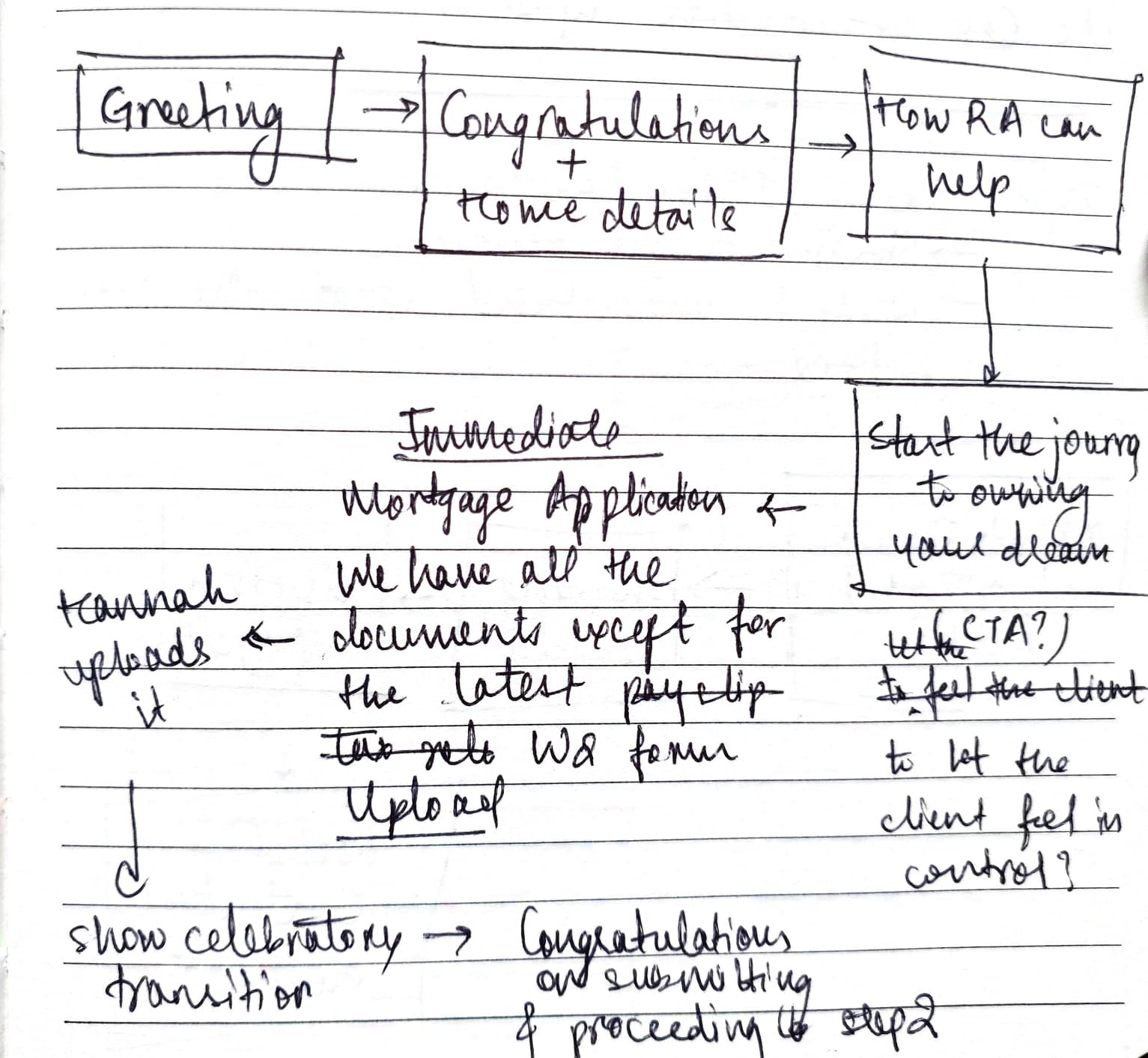
Mapping out the conversation flow to identify UI design interventions.
This approach acknowledged the limits of automation while preserving the convenience of the assistant. By making escalation simple and transparent, the system maintained trust and ensured that clients could receive the right help at the right moment.
moving the needle
Validating the experience and shaping future product direction
After introducing the interaction patterns, I submitted the redesigned conversational prototype for Rapid Concept Testing with Rocket Mortgage clients and internal stakeholders.
The goal was to understand whether contextual guidance and integrated UI elements would help clients feel more confident navigating the post-offer stage, while also evaluating how these interaction patterns could support Rocket’s broader conversational AI roadmap.
Client Validation
Usability sessions with Rocket Mortgage clients explored how the redesigned assistant experience supported decision-making during the post-offer stage. Participants interacted with prototypes that combined conversational guidance, embedded UI elements, and contextual recommendations.
The results showed that clients valued responses tailored to their specific situation and appreciated having actionable steps surfaced directly within the conversation.
of clients felt that tailored responses were helpful for their homebuying journey and stage.
“I like that it [Rocket Assist] realized that the home has a pool so I would need a pool inspection done too…giving relevant info…”
of clients liked that inspector recommendations were from their realtor, felt this was personalized.
“I like the inspector recommendations from my realtor, rather than those who might have paid for advertisement on this app."
of clients said having immediate options for chat transfer reduces frustration.
“I also really like that it [Rocket Assist] gives me the option and the wait time to connect to a human being for stuff that is sensitive…”
product Influence
Beyond user validation, the concepts I explored in this project also informed conversations within the Rocket Mortgage conversational AI team. By working closely with engineers, researchers and domain experts, the interaction patterns I introduced helped illustrate how conversational interfaces could move beyond messaging UI.
Early reviews of these interaction patterns helped surface new opportunities for integrating APIs, enabling direct client transfers and embedding structured UI components inside the assistant experience. Several of these concepts contributed to ongoing roadmap discussions around how Rocket’s conversational AI products could better support clients during complex financial journeys.
"Pri routinely sought out and addressed challenging issues, independently identified critical opportunities for improvement, and delivered results on par with a full-time associate designer."
AMANDA MATZENBACH
" height="72px" id="SaFXoHQJ0" width="72px"/><path d="M 52 52 L 41.316 52 L 41.316 33.802 C 41.316 28.812 39.42 26.025 35.471 26.025 C 31.175 26.025 28.931 28.926 28.931 33.802 L 28.931 52 L 18.632 52 L 18.632 17.333 L 28.93 17.333 L 28.93 22.003 C 28.93 22.003 32.026 16.274 39.383 16.274 C 46.736 16.274 52 20.764 52 30.051 Z M 6.349 12.794 C 2.841 12.793 0 9.93 0 6.397 C 0 2.864 2.842 0 6.35 0 C 9.857 0 12.697 2.864 12.697 6.397 C 12.697 9.93 9.858 12.793 6.35 12.794 Z M 1.033 52 L 1.033 17.333 L 11.768 17.333 L 11.768 52 Z" fill="rgb(255, 255, 255)" height="52.00000018310547px" id="Yz1qSGNjM" transform="translate(10 10)" width="52px"/></svg>)
Conversational AI Design Manager & Mentor
Rocket Mortgage
"This was perhaps her most complex assignment, and Pri quickly mapped key friction points while collaborating with engineers and researchers. Her work helped influence product roadmap priorities."
DANA LEE
Director of Conversational AI Design & Digital Product Management
Rocket Mortgage